Ovarian Cancer Test (Practitioners) - geneType™

geneType™ for Ovarian Cancer provides an integrated risk assessment

By integrating clinical, familial and genetic risk factors

geneType™ for Ovarian Cancer can facilitate joint-decision-making discussions around risk-reducing options for your patients by providing her absolute risk of developing ovarian cancer.

Testing is simple

Step 1

Register as a provider; our team will provide clinical education and other resources as needed.

We will send kits to your clinic to have on hand.

Step 2

Discuss geneType™ with your patient.

Would geneType™ help them qualify for additional risk reduction strategies?

Step 3

Complete the Test Requisition form, collect a saliva sample from the patient with the collection kit provided and return both to Rhythm.

You will have the option to use a paper requisition, or a secure, compliant portal to complete the ordering process.

Step 4

Leave the rest to us.

We will notify you when your patient’s results are ready.

You will have the option to request a consult with a genetic counsellor,  whether to review your patient’s results and/or to follow-up with your patient, as needed.

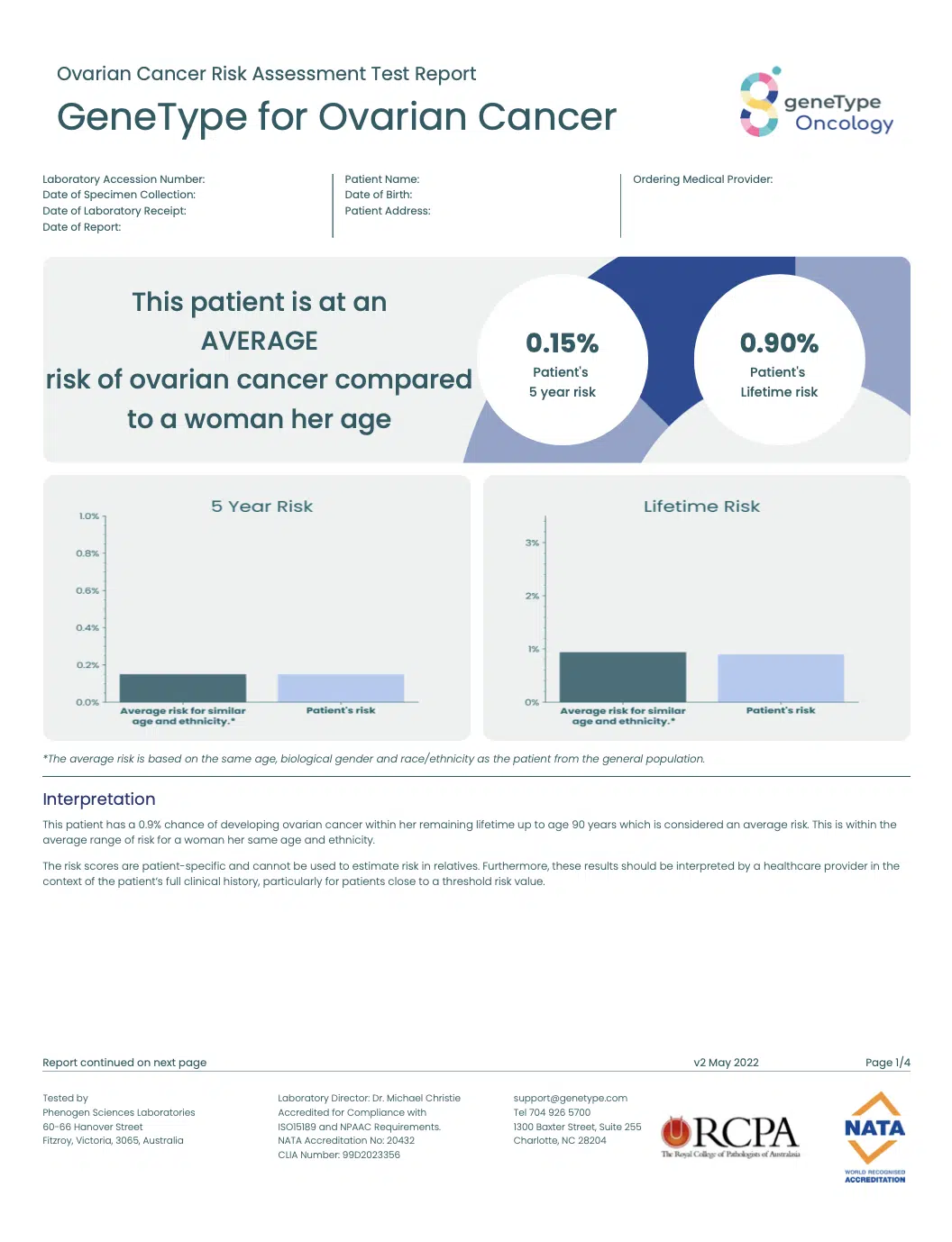
Sample patient report

Traditional risk assessment + polygenic risk score

Facilitates joint-decision-making discussion around risk-reducing options1,2

One report with actionable clinical insights

geneType™ reports are structured to make the results easy to interpret and communicate to a patient. The geneType™ for Ovarian Cancer report includes: snapshot of your patient’s 5-year and lifetime-risk scores interpretation of what their risk scores mean in the context of your local guidelines polygenic risk score indicating your patient’s “baseline” ovarian cancer risk information about managing ovarian cancer risk factors and the types of screening that may be relevant to your risk

Who is suitable for geneType for Prostate Cancer

  • Women
  • Aged 40 years or older
  • No known hereditary breast and ovarian cancer (HBOC) gene mutation e.g. BRCA1 or BRCA2

Have questions? We have answers.

If your question is not shown here, please Contact us directly.

Is this test medicare reimbursed?
No.
Does this test for the BRCA1 or BRCA2 genes?

No. This risk assessment does not test for hereditary breast and ovarian cancer (HBOC), or any other hereditary cancer syndrome. geneType is a risk assessment for asymptomatic women in the general population who are either ineligible for HBOC testing, or who have come back as negative carriers following HBOC testing.

How old does my patient have to be to use this test?

GeneType for Ovarian Cancer is suitable for women aged 40 years or older.

In which ethnicities is this test validated?

GeneType for Ovarian Cancer is currently validated in women of Caucasian descent and relies on the patient correctly reporting their ethnicity. Other ethnicities are under investigation but risk scores are not yet available.

Can I order this test if my patient has already tested positive for HBOC (ie. BRCA1 or BRCA2)?

No. This test is not applicable to women who have a personal history of ovarian cancer or who have already been shown to have an HBOC mutation, for example in the BRCA1 or BRCA2 gene, or a diagnosis of a genetic syndrome that may be associated with elevated risk of ovarian cancer.

What’s the difference between geneType and a liquid biopsy?

GeneType is a risk assessment tool to enable you to stratify your patient population. Liquid biopsies, such as the Galleri test are novel, but pricey screening options. A risk stratification tool can be a tool to identify those of your patients that might benefit from a novel screening tool like this one given the paucity of effective early detection tools available.

Available to Medical Practitioners

GeneType Multi Test

A combination of geneType tests for breast cancer, colorectal cancer, ovarian cancer, prostate cancer, coronary artery disease and type 2 diabetes in a single test.

Know your risk of a serious disease to tailor a personalised prevention plan with your medical practitioner.

References
  1. US Preventive Services Task Force. JAMA 2018;319(6):588–594.
  2. NCCN Clinical Practice Guidelines in Oncology (NCCN Guidelines®). Genetic/Familial High-Risk Assessment: Breast, Ovarian, and Pancreatic. Version 2.2022 — March 9, 2022.

Accredited For Compliance With NPAAC Standards And ISO 15189